George Washington Carver
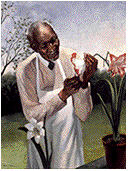
According to historians, George Washington Carver was born in Diamond Grove Missouri, in 1865 to Mary Carver, a slave owned by Susan and Moses Carver. The uncertainty of his birth date relates to the fact that many slaves owners were lax in recording the births of slaves. Although there is uncertainty about his paternity, Carver claimed that his father was a slave on a neighbouring plantation. Soon after his birth, George and his mother were kidnapped by Confederate bushwhackers. He was later returned to the Carvers who raised him, but his mother was never seen again. .As a child, Carver often wondered in the woods collecting rocks and flowers. He nurtured the flowers in his small private garden. and through his work with flowers, he acquired the nickname of the "plant doctor." This early love of nature and the desire to understand his surroundings influenced Carver's future work.
At the age of 12, George left the Carver's farm to attend a nearby school for Blacks and never returned. Because racism was a constant barrier, Carver struggled to get an education. Although it took twenty years to complete his education, his belief in God enabled him to persevere. He received his high school diploma, while working as a farm hand. He attended Iowa Agricultural College while working as the school janitor. Carver received a BS (1894) and a Master's degree (1896) and became the first black to serve on Iowa's faculty. Shortly after, Carver joined the faculty of Tuskegee University(1896) to work with Booker T. Washington. While at Tuskegee, Carver used the surplus of peanuts to develop 325 products such as peanut milk that saved the lives of African babies. Carver also obtained 75 products stemming from pecans, 118 industrial applications from agricultural products and over 500 dyes and pigments from 28 different plants.
Although he invented many products, Carver only filed for and received three patents for his work with paints and stains. A deeply religious person, he explained his rationale for not seeking other patents as follows; "God gave them to me, how can I sell them to someone else?" Carver was also offered very lucrative salaries to work for Thomas Edison and Henry Ford. However his commitment to work for the improvement of the quality of life for others, overrode his desire for personal wealth. "If I took the money I might forget my people," he said.
Carver, having been a victim of racial prejudice, set a goal for himself in which he captured the imagination of the American people. This brilliant and humble scientist died of anaemia on January 5, 1943 and is buried next to Booker T. Washington, founder of Tuskegee University. George Washington Carver will always be remembered for the many contributions he selflessly gave for the betterment of society.
Here is a link to a website about George Washington Carver
By: Charmaine
Created & last updated March April 4, 2000 by Charmaine