CROSS-COUNTRY SKIING
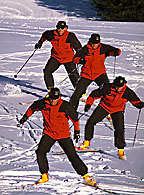
Cross country skiing was known to exist around 5,000 years ago. It was better known in around 1,200 B.C. when Swedish Scouts used them to follow their enemies in the battle of Oslo. Today cross-country skis are made out of wood or fibreglass. You clip your foot in a binding that is attached to the ski, somewhat like downhill skiing except your foot can move.
In cross-country skiing there are two styles. There is the skating style and the classic style. In the classic style you move your skis horizontally over the snow one at a time in the track. You move one pole at a time making you go faster and helping you go up hills. You use poles that go up to your armpits and skis slightly taller than you. The other style is skating. In this style you do the same as ice skating except you use your skis. You also have the help of your poles. You use your poles in the style of double poling. This means that you push both poles at the same time off the ground. Your poles go up to your ears and your skis are your slightly smaller than you. Generally the skating style is faster than the classic style.
There are four main types of bindings. The first is the three pin binding. This is where you have a boot and you fit it in to three slots or pins. This is the oldest kind and as you can imagine the worst. The next kind is the SNS binding. This is where you put a piece of metal over another so the boot clips to the binding. This binding was used by many people for a long time. The next kind of binding is the NNN binding. In this binding you put a horizontal piece of metal in a slit. This not a very good binding because it can break easily. The last binding is the SNS profil binding. This is very similar to the NNN binding except the back of the binding is different which provides more stability. It is the best kind of binding, the newest and not surprisingly the most expensive.
Waxes are very important to the performance of the cross-country skier. Without them it would be very hard to ski. You can of course get unwaxed skis which have a sort of fish scale on them. These however are not very good. When you skate you do not need wax on your skis. The different types of waxes are red, purple, blue, green, and white. They go from +5 degrees Celsius to -30 degrees Celsius covering about 5 degrees Celsius on average. You can also get Extras or Specials for each wax covering a more precise span of temperature.
Quiz
Picture taken from http://www.skinnyski.com/schools.html
For a cross-country skiing site click here!
E-mail me with questions or comments
Created and last updated by Julian April 10th 2000